Short Description
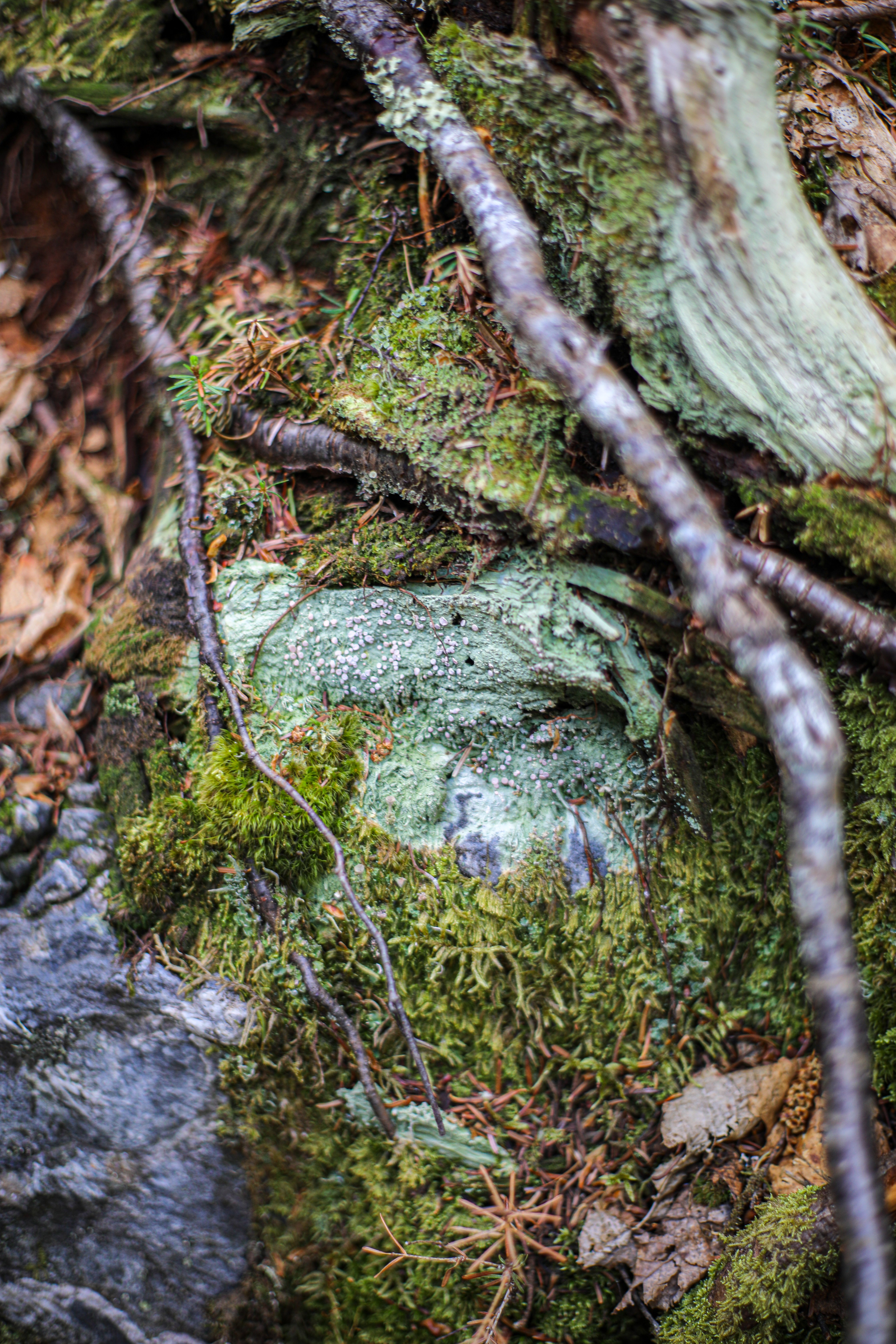
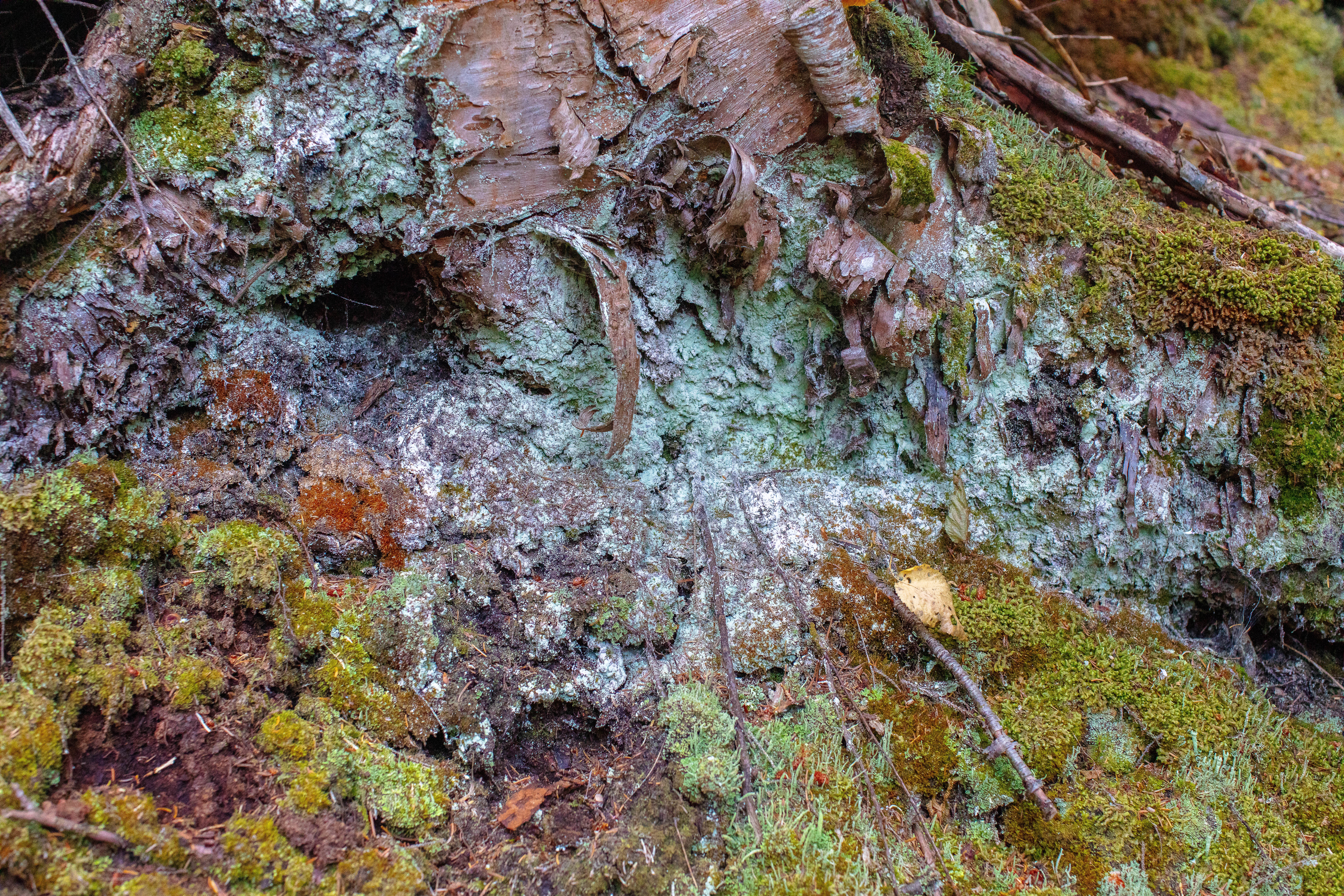
This oddly named lichen, also known as Fairy Barf or Candy Lichen, certainly catches the eye: imagine a splash of mint-green crust on a decaying log, peppered with tiny bright pink polka dots – as if a fairy had a too-sweet snack and, well, you get the idea. Fairy Puke Lichen grows on very rotten wood, moss, or peat in humid, shaded forests. Along the lower Howker Ridge Trail, you might find it on moss-covered stumps or downed spruce logs in the shady understory. The pink “dots” are its apothecia – spore-producing structures – and are a true bubblegum pink, about 1–2 mm across. They can be sparse or so numerous that they almost cover the greenish thallus. Finding this lichen delights hikers with an eye for tiny things; it’s like discovering a secret fairy world on a stump. Despite the playful appearance, it’s a fully functioning symbiosis of fungus and algae, breaking down wood and adding splashes of color to the forest floor.
TYPE
Lichen
ELEVATION
500–4,000 ft (in forested zones, rarely to treeline on old stumps)
HABITAT
Mossy, decaying wood in moist conifer forests; rotting logs, stumps, and peaty soil in shaded areas
BLOOM / SEASON
Non-flowering (lichen; pink spore discs appear during wet periods)
LEAF & STEM
A crustose lichen forming irregular patches (up to several inches across) on rotted wood or soil. The main body (thallus) is a thin, pale green to bluish-green crust that grows over moss or decayed wood fibers. Often it’s so integrated that you can’t peel it off without crumbling the substrate. Embedded in this crust are the distinctive apothecia: round, convex discs that are pink to salmon in color, usually ~1 mm in diameter (about the size of a pinhead). These may sit directly on the thallus or on very short stalks. When wet, the pink apothecia can look gelatinous; when dry they are duller. The combination of green thallus and pink dots is unmistakable. If you scrape a bit of the green crust, you’d see it has no obvious structure like leaves – it’s a granular layer of fungal tissue with algae. No stems, no leaves, no flowers – it’s a lichen through and through.
SIMILAR SPECIES
Fairy Puke Lichen might be confused with the Pink Earth Lichen (Dibaeis baeomyces), which also has pink apothecial dots. The difference is substrate and structure: pink earth lichen grows on soil, often on bare ground or sand, and its pink apothecia are atop slightly longer stalks, giving a miniature “lollipop” look. Fairy Puke prefers well-rotted logs or very mossy soil and appears more as a flush on a surface, with sessile (nearly stalkless) pink dots. Also, Dibaeis usually lacks the bright mint-green smooth crust that Icmadophila has. Other crustose lichens on wood (like Graphis or Phlyctis) have gray or black fruiting bodies, so they don’t resemble Fairy Puke at all. One could mistake the pink apothecia for fungal fruit bodies (like tiny coral fungus tips), but under a hand lens the context of a green lichen thallus is clear. In short: bright pink on green, on rotten log = Fairy Puke likely.
ECOLOGY
Icmadophila (Fairy Puke) is found in cool, damp forests, often indicating well-established or old-growth conditions where plenty of logs are decomposing. It “eats” decaying wood in a sense – the fungal partner physically grows through rotten logs, and the algal partner photosynthesizes to feed them both, making it a partial autotroph. It often overgrows mosses on logs; in fact it is described as growing aggressively over mosses on well-rotted wood and peat. By breaking down logs, it contributes to the nutrient cycling in the forest, albeit slowly. It has no known direct economic importance (aside from looking pretty), but it does signal a healthy, moist microclimate. It likely relies on consistent humidity; if a forest is cut and dries out, this lichen can disappear. It does not tolerate pollution well and prefers pristine air and water drip conditions. In the White Mountains, it can occur up into subalpine elevations wherever old stumps persist (for example, krummholz edge where a tree died and rots). Spore dispersal (from those pink apothecia) helps it colonize new logs, but it’s not a fast-spreading species. Overall, Fairy Puke lichen plays a subtle role in forest ecology – one of countless organisms quietly decomposing and enriching the soil.
STATUS
This lichen is not rare globally – it’s found across the Northern Hemisphere’s forests (even in some arctic areas). However, it can be locally uncommon because it needs specific conditions (very decayed wood, constant moisture). In New Hampshire it’s recorded in many counties but never in large abundance. It has no special conservation status. The main threat would be loss of habitat: overly tidy forestry that removes dead wood, or severe pollution drying out or poisoning substrates. The good news is that within the White Mountain National Forest, plenty of rotting logs and pristine air means Fairy Puke has its niche. Its presence often goes unnoticed by all but keen observers. Conservation of old-growth forest patches and maintenance of coarse woody debris in forests indirectly ensure this quirky lichen continues to delight hikers who take the time to look closely. If you find it, enjoy the find and maybe snap a photo – but do not disturb it, as lichens are slow-growing and sensitive.
Field Notes
- A crustose lichen forming irregular patches (up to several inches across) on rotted wood or soil. The main body (thallus) is a thin, pale green to bluish-green crust that grows over moss or decayed wood fibers. Often it’s so integrated that you can’t peel it off without crumbling the substrate. Embedded in this crust are the distinctive apothecia: round, convex discs that are pink to salmon in color, usually ~1 mm in diameter (about the size of a pinhead). These may sit directly on the thallus or on very short stalks. When wet, the pink apothecia can look gelatinous; when dry they are duller. The combination of green thallus and pink dots is unmistakable. If you scrape a bit of the green crust, you’d see it has no obvious structure like leaves – it’s a granular layer of fungal tissue with algae. No stems, no leaves, no flowers – it’s a lichen through and through.
- Icmadophila (Fairy Puke) is found in cool, damp forests, often indicating well-established or old-growth conditions where plenty of logs are decomposing. It “eats” decaying wood in a sense – the fungal partner physically grows through rotten logs, and the algal partner photosynthesizes to feed them both, making it a partial autotroph. It often overgrows mosses on logs; in fact it is described as growing aggressively over mosses on well-rotted wood and peat. By breaking down logs, it contributes to the nutrient cycling in the forest, albeit slowly. It has no known direct economic importance (aside from looking pretty), but it does signal a healthy, moist microclimate. It likely relies on consistent humidity; if a forest is cut and dries out, this lichen can disappear. It does not tolerate pollution well and prefers pristine air and water drip conditions. In the White Mountains, it can occur up into subalpine elevations wherever old stumps persist (for example, krummholz edge where a tree died and rots). Spore dispersal (from those pink apothecia) helps it colonize new logs, but it’s not a fast-spreading species. Overall, Fairy Puke lichen plays a subtle role in forest ecology – one of countless organisms quietly decomposing and enriching the soil.
- This lichen is not rare globally – it’s found across the Northern Hemisphere’s forests (even in some arctic areas). However, it can be locally uncommon because it needs specific conditions (very decayed wood, constant moisture). In New Hampshire it’s recorded in many counties but never in large abundance. It has no special conservation status. The main threat would be loss of habitat: overly tidy forestry that removes dead wood, or severe pollution drying out or poisoning substrates. The good news is that within the White Mountain National Forest, plenty of rotting logs and pristine air means Fairy Puke has its niche. Its presence often goes unnoticed by all but keen observers. Conservation of old-growth forest patches and maintenance of coarse woody debris in forests indirectly ensure this quirky lichen continues to delight hikers who take the time to look closely. If you find it, enjoy the find and maybe snap a photo – but do not disturb it, as lichens are slow-growing and sensitive.
Photo Credits
(c) Nathan Sobol / NH48pics.com

