Overview
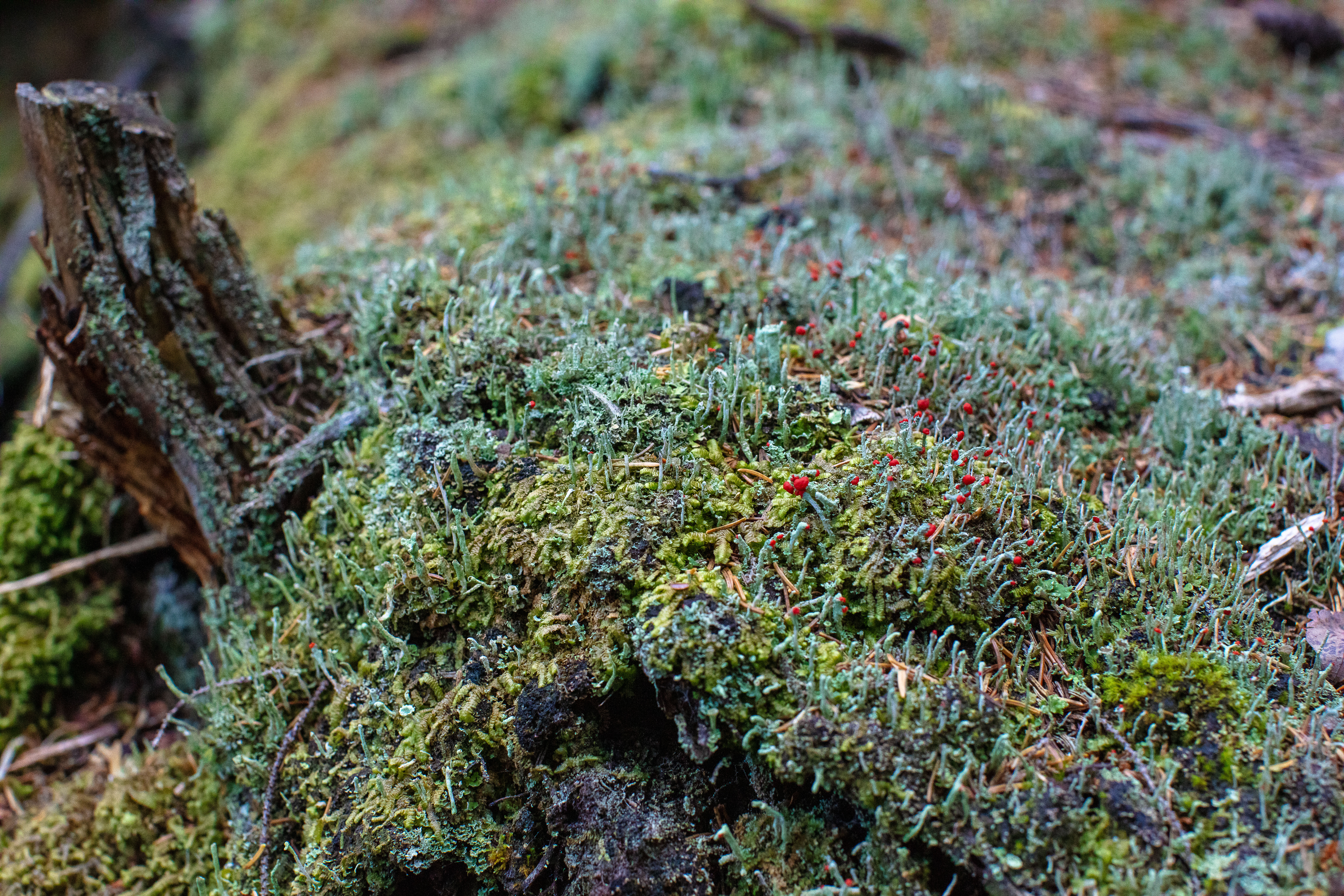
A tiny gray-green lichen that looks like a miniature forest outpost - its upright stalks capped with brilliant red "hats," like an army of toy soldiers standing at attention on a mossy log.
Ecology
British Soldier Lichen shares a similar ecological role with other reindeer and Cladonia lichens but in more mesic, sheltered microhabitats. It typically grows where it has partial protection - e.g., the side of a decaying log facing away from prevailing winds, or at the base of a tree - which suggests it doesn't thrive in extreme exposure. By growing on decaying wood and soil, it contributes to **decomposition** and soil formation. Like pixie-cups, it secretes lichen acids that break down wood fibers and even mineral particles. It also competes with mosses: sometimes you'll see it poking out of a moss carpet; it benefits if the moss is low-growing so that it can still get sun on its algae. Lichens including British Soldiers are pioneers on bare, poor substrates - they can colonize nutrient-poor sand or rotting stumps where vascular plants struggle. They absorb everything they need from rain, fog, and dust (which includes nutrients like nitrogen or calcium in minute amounts). One interesting aspect is their sensitivity to air quality: Cladonia cristatella will die off if air pollution (sulfur dioxide, ozone, heavy metals) is too high, making it an indicator species for clean, unpolluted forests, much like many lichens. In terms of food web, few animals eat British Soldier Lichen because of the acids and low nutritional value, though some species of snails have been recorded feeding on Cladonia. The lichen's presence does offer a tiny vantage or display ground for micro-fauna; for example, certain springtails might use lichen stalks as perches to launch themselves. Also, hummingbirds and some songbirds have been known to incorporate lichens into their nests as camouflage or binding material - they prefer filamentous lichens (like old man's beard), but occasionally tufted lichens may be picked off and used. It's not documented specifically for this species, but any lichen on a branch could become nest decor. British Soldiers reproduce a lot by spores (as evidenced by many apothecia), but since those spores need to find algae, the more reliable reproduction is when a chunk breaks off containing both partners. Heavy rain or animals brushing against it can fragment the lichen and scatter pieces which can re-establish elsewhere. Over decades, British Soldier Lichen can colonize a series of stumps in a clearing, flourish, and then as those stumps fully rot and are overgrown by shrubs, the lichen's cycle ends in that spot - it is outcompeted and shaded out by higher plants. However, in a healthy mosaic of forest gaps, there will always be new logs and soil patches opening up for it to colonize, maintaining its presence in the ecosystem. As such, it plays a dynamic role in forest regeneration: one of the first to adorn a fresh log or soil mound, making the most of the gap until bigger life-forms take over. Its bright red tops might even serve as a visual lure for some insects (certain red aphids or mites might be drawn to them, for instance), but more research would be needed. At the very least, they serve as a delightful visual for human observers, adding aesthetic value to the forest floor - which in a broad sense fosters human appreciation for conserving such habitats.